


Wait a minute Rachel, haven’t you written about this before? YES!
Investing comes with so many misconceptions that just won’t die- the culprit is usually the tendency to confuse “trading” with “lifelong investing.”
One of the most stubborn myths in investing goes something like this:
“I don’t want to put new money in right now because the market is at a high. I’ll wait for a dip.”
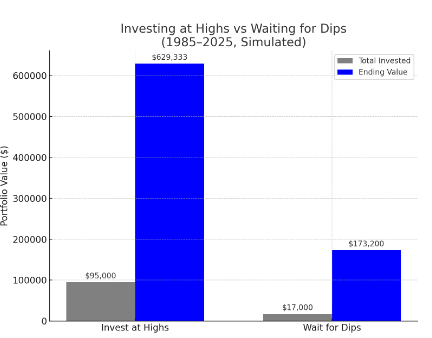
It sounds logical. Nobody wants to buy at the peak, right? But here’s the catch: for long-term investors, “buying high” is, frankly, inconsequential.
Maybe once you got lucky and want to repeat that, or had bad timing and want to avoid it. After time passed, can you really put a dollar amount on the outcome?
Why Market “Highs” Are Normal
If the stock market didn’t regularly hit new highs, it would mean something is very wrong. Over the long run, businesses grow, earnings expand, economies increase in productivity, and prices rise to reflect that growth.
New highs aren’t a warning sign—they’re the norm.
The S&P 500, for example, has hit thousands of “new highs” in its history. And what usually follows a new high? Eventually… another new high.
The “Dip” Mirage
Waiting for a dip sounds smart in theory. But dips aren’t scheduled. They don’t arrive when your paycheck clears. Sometimes you wait weeks. Sometimes years. Sometimes you finally see a dip… and it’s higher than the last so-called “peak.”
In other words, waiting often means sitting on the sidelines while your money misses compounding.
The Long-Term Perspective
Let’s put this in perspective:
If you invested in the S&P 500 at an all-time high any given month over the past 40 years and just held on, your returns were overwhelmingly positive 10, 20, and 30 years later.
The “bad” outcome isn’t buying at a high—it’s not buying at all.
When you stretch your time horizon to decades, today’s “expensive” prices often look like bargains in hindsight.
The Emotional Trap
At the root of this hesitation is fear:
Fear of regret if the market dips tomorrow.
Fear of “looking dumb” for buying at the wrong time.
But investing isn’t about feelings. It’s about probabilities. And history shows that long-term, disciplined investors who stay invested—through highs, lows, and sideways stretches—tend to outperform those who try to time the market.
The Better Way to Think About It
Instead of asking, “Is this a high?” try asking:
“Will this money likely be worth more in 10, 20, or 30 years if I invest it today?”
“Am I sticking to my plan, or am I letting short-term noise hijack my strategy?”
For almost all lifelong, buy-and-hold investors, the answer is simple: invest when you have money to invest. Don’t overcomplicate it.
Final Word
Every all-time high in history once looked scary. And every investor who sat out, waiting for the “right time,” eventually learned that compounding doesn’t care about nerves—it only cares about time in the market.
So, the next time you hear yourself say, “But the market is at a high,” just remember: that’s exactly where it’s supposed to be. And chances are, in the future you will look back and wonder why you thought today’s prices were expensive at all.
Content in this material is for general information only and not intended to provide specific advice or recommendations for any individual. All performance referenced is historical and is no guarantee of future results.
Securities offered through LPL Financial, Member FINRA/SIPC. Investment advice offered through Western Wealth Management LLC , a registered investment advisor. Western Wealth Management LLC and Kennebec Wealth Management LLC are separate entities from LPL Financial.